

Greek myths tell stories of love, tragedy and human nature: The legend of Perseus
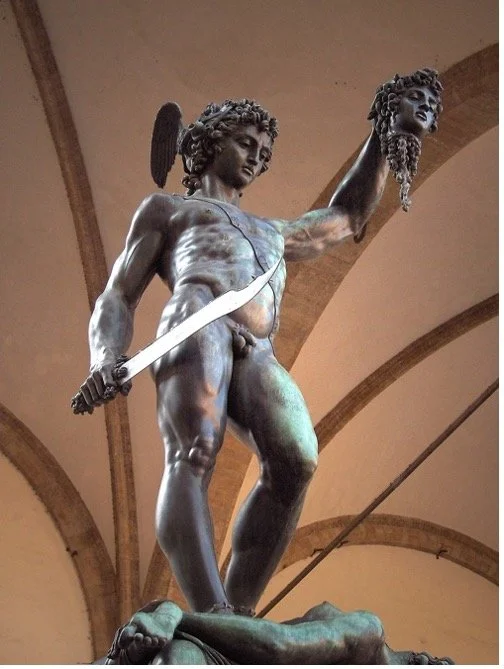
Perseus by Benvenuto Cellini, Loggia dei Lanzi, Florence, Italy
The tale goes that in the Bronze Age (~1400 BC), King Acrisius of Argos had only one child, a daughter named Danaë. Disappointed at not having a male heir, he consulted the Oracle at Delphi, who warned him that he would one day be killed by his own grandson. To prevent Danaë from having children, Acrisius imprisoned her in a room atop a bronze tower within the courtyard of his palace. However, Zeus came to her in the form of a shower of gold and fathered her child. Soon after, a son was born, Perseus.
Fearful still of the oracle, Acrisius placed mother and child into a wooden chest and cast them into the sea. By divine will they survived, drifting across the Aegean until they came ashore on the island of Seriphos, where they were discovered by a humble fisherman who brought them to safety. Perseus was raised in obscurity, growing into a strong and capable youth far from the court of Argos.
At that time Seriphos was ruled by King Polydectes, a ruler often portrayed as calculating and ambitious, who desired Danaë for himself. Perseus, now grown, stood as an obstacle to his intentions. Seeking to remove him Polydectes devised a scheme under the guise of noble contest and challenged the young man to bring him back the most dangerous gift of all- the head of Medusa.
Medusa, one of the Gorgons, was a creature of such terror that any who looked upon her were turned instantly to stone. The task was intended as a death sentence disguised as a heroic quest. Yet Perseus was not abandoned. The gods aided him: Hermes, god of messengers gave him winged sandals, and a curved sword; Hades, god of the underworld offered a helm of invisibility, while Athena, goddess of wisdom and strategy provided him with a polished shield.
Thus equipped, Perseus journeyed to the edge of the known world to the mythical Island of Sarpedon, a remote island at the edge of the known world near Libya. and found Medusa among her stone-bound victims. Avoiding her gaze by watching only her reflection, he struck and severed her head. From her blood sprang Pegasus and Chrysaor, remnants of her monstrous and divine lineage.
More adventures awaited Perseus on his long journey home, for even after the death of Medusa, the hero’s path was not yet finished. The sea winds that carried him away from the Gorgon’s lair did not lead him straight back to safety, but instead drew him across unfamiliar shores and into lands still shaped by gods, monsters, and ancient curses.
To be continued…
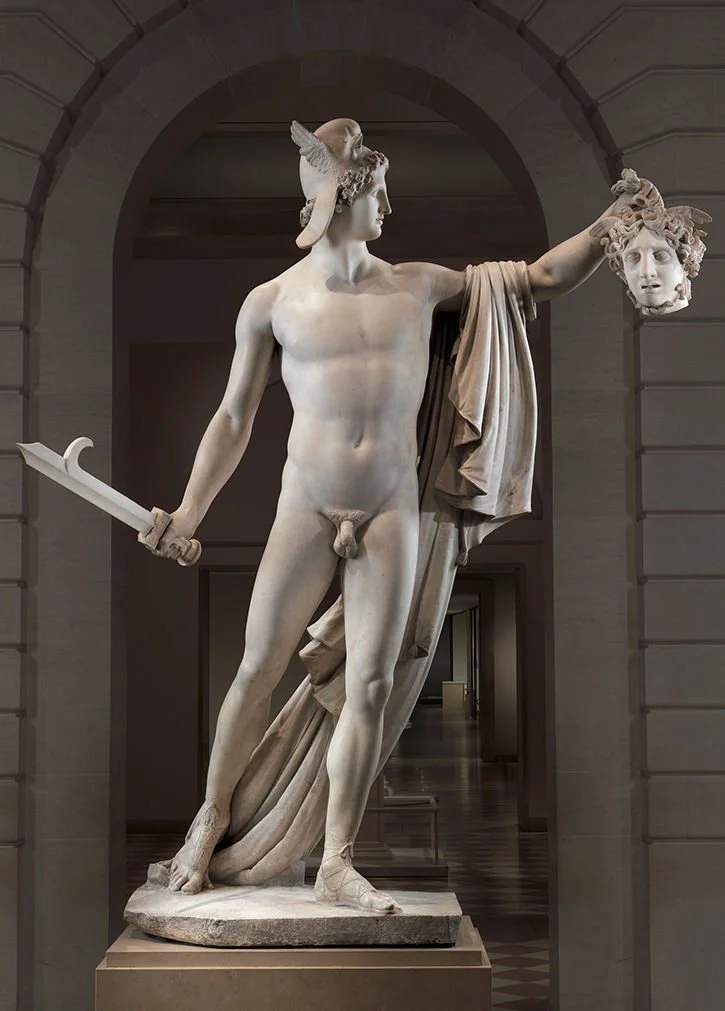
Antonio Canova (Italian, 1757–1822). Perseus with the Head of Medusa, 1804–6. Marble. The Metropolitan Museum of Art, New York, Fletcher Fund, 1967 (67.110.1)
"It's a sculpture about motion, but it's not the motion of killing."
—Peter Bell, curator
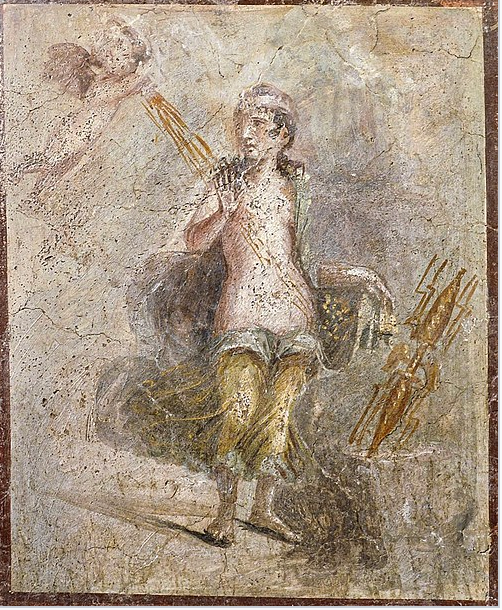
Perseus with the head of Medusa, first century AD, Museo Ostiense. Ostia, Roma, Italy
