

Greek myths tell stories of love, tragedy and human nature:The myth of Orpheus and Eurydice

Orpheus playing the lyre surrounded by animals in a Roman floor mosaic in the Museo archeologico regionale di Palermo © Giovanni Dall'Orto
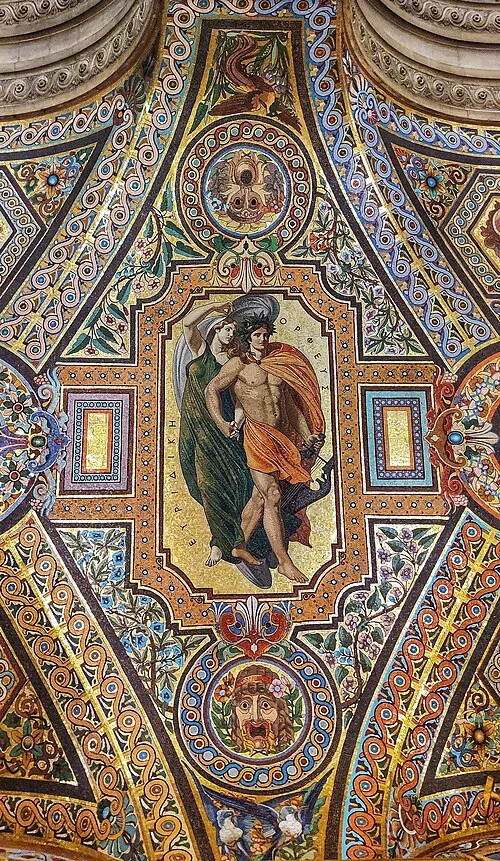
Orpheus and Eurydice in Palais Garnier, Paris. Their names are in Greek, ΟΡΦΕΥΣ (Orpheus) and ΕΥΡΥΔΙΚΗ (Eurydice)
The myth of Orpheus dates back to Ancient Greece, with its roots in even older legends, in the late Bronze Age,(around 1300–1200 BC); the most well-known and influential version of the story comes to us from the great Roman poets Virgil and Ovid in the late century 1 BC:
Orpheus is a poet and musician whose playing of the kithara (a harp-like lyre) is so divine that the birds, the beasts, even the stones and the trees move to the rhythm of his songs. Shortly after his marriage to the nymph Eurydice, the newlyweds are cruelly parted when she dies after being bitten by a viper.
Filled with grief, Orpheus cannot accept the loss of his adored bride, and he decides to journey to the Underworld to bring her back. His musical gifts charm Cerberus, the three-headed dog who guards the gates, and allow him finally to reach the god of the Underworld, Hades, and his wife, Persephone. He beguiles them, too, with his song, and Hades tells Orpheus that he can take Eurydice back with him, under one condition: she must follow behind him as they emerge from the Underworld, and he must not turn to look at her.
Overjoyed at being set this simple task, Orpheus thanks the gods and begins his ascent. But, unable to hear Eurydice’s footsteps, he starts to fear that Hades has fooled him. As he nears the exit from the Underworld, he turns to see Eurydice behind him, and she is trapped forever.
Devastated by this final separation and unable to return to the Underworld himself, Orpheus plays a mourning song on his lyre and is torn to pieces by a band of Maenads (female followers of the god Dionysus). His head remains intact, and continues to sing as it floats off on the waters.
https://www.operanorth.co.uk/news/looking-back-the-orpheus-story/
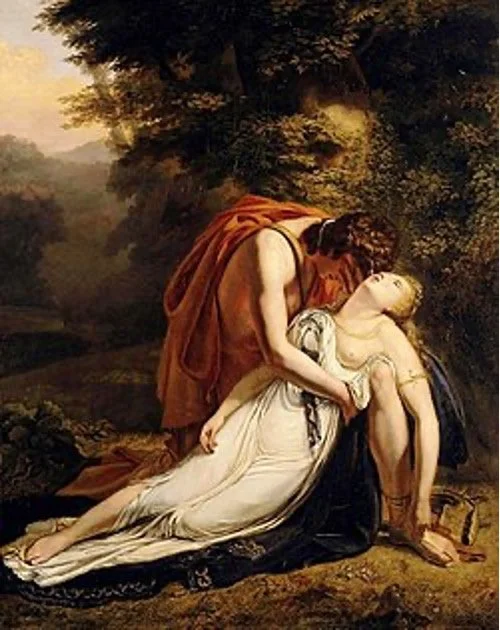
Orpheus Mourning the Death of Eurydice,
1814 painting by Dutch French Romantic
painter Ary Scheffer.